7. Distance: accuracy and calibration
Read this early. A tripmaster is only as good as its distances, and the organiser's kilometre will never equal your GPS kilometre. The organiser measured the route with a surveyed wheel; you are measuring it with satellites. Calibration is the setting that reconciles the two, and it matters in every discipline.
7.1 Required accuracy
Settings ▸ GPS & devices ▸ Required accuracy: Low, Medium, High (default: High).
| Level | Accepts fixes within |
|---|---|
| High | 10 m |
| Medium | 20 m |
| Low | 50 m |
This is the horizontal accuracy a fix must meet before it counts toward distance. Demanding more gives cleaner distances but discards more fixes, which matters under trees, in canyons and between buildings.
- High is right for open roads and competition.
- Drop to Medium if the app is visibly ignoring movement in difficult terrain.
- Low is a last resort, and it will let noisy fixes into your totals.
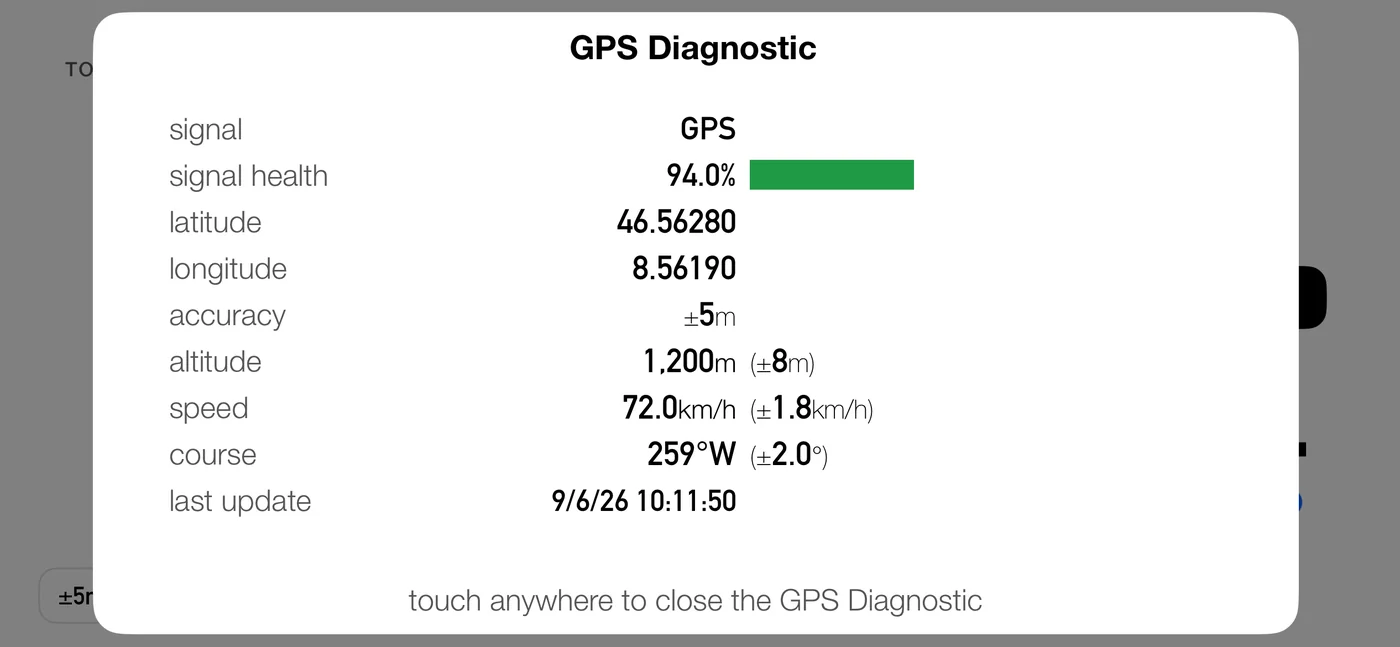
Settings ▸ GPS & devices ▸ GPS diagnostic, or a double tap on the GPS accuracy readout on the dashboard (the ±5 m), shows the live picture: the fix source, the accuracy, and why individual fixes were rejected.
7.2 Calibrating against a measured distance
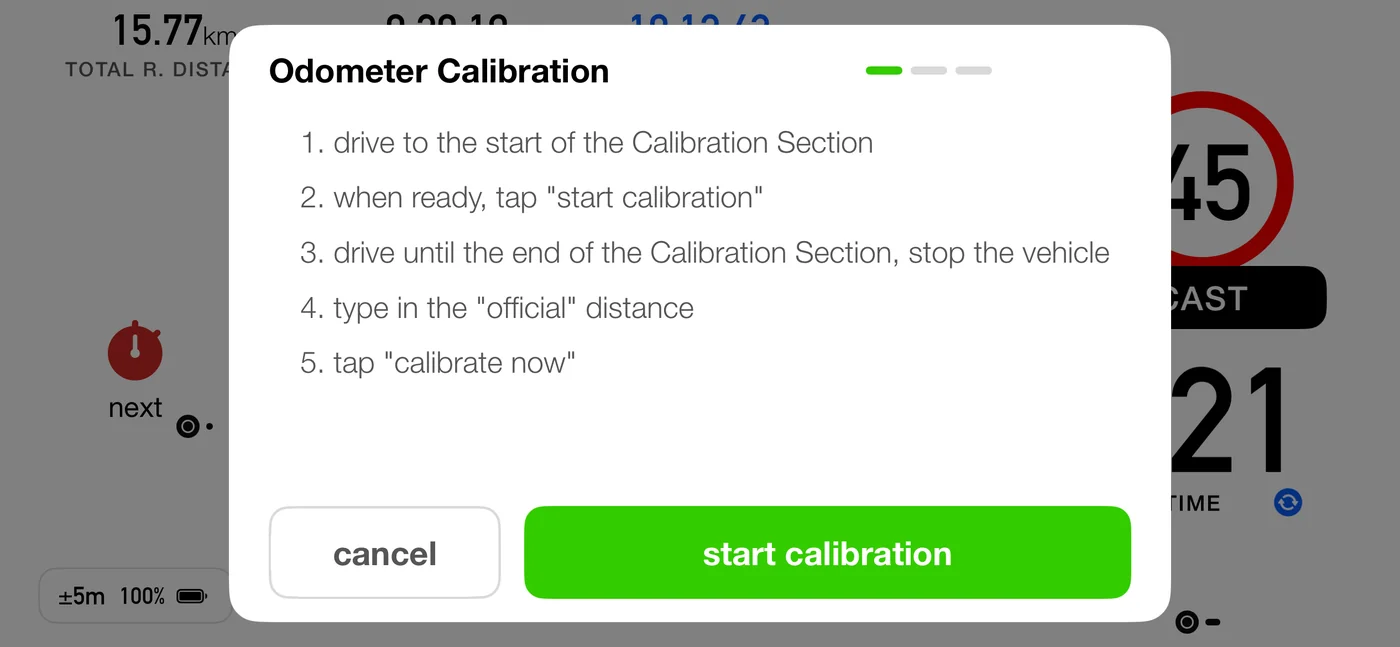
Reach the calibration screen from the calibrate button on the idle dashboard. It is shown in Advanced and Roadbook. In Classic there is a simpler way: while running, double-tap a distance and set the correction as a percentage in the adjust dialog (7.4).
- Go to a known measured distance, ideally the organiser's own calibration leg.
- Tap start calibration at the beginning.
- Drive it, and stop at the end.
- Type the official distance.
- Tap calibrate now. It reads the distance you typed, so type it first.
- The screen shows
measured X · official Yand the correction it will apply. Confirm it, or restart to try again.
The measurement runs from the first tap to the second, and nothing outside them counts, so you can start and finish it while moving. A longer leg is still the safer one: any small error at either end matters less the further you drive.
reset calibration clears any correction back to zero.
The sanity checks
A wrong calibration silently poisons every distance afterwards, so the app pushes back:
| Result | What happens |
|---|---|
| Correction over 30% | Rejected. The resulting calibration is too high. Please repeat the calibration. |
| Correction over 10% | Warning. Are you sure the distance you typed in is correct? |
| Difference smaller than your accuracy threshold | Warning: the difference is inside the noise, so the result means nothing |
⚠️ Calibrate over a long leg. A 1% error over 2 km is 20 m, which is inside GPS noise. Over 20 km it is 200 m, and the result is trustworthy.
7.3 Letting the app learn it from your controls
Settings ▸ Roadbook ▸ Learn calibration from controls (the Roadbook section appears while Mode is set to Roadbook) does the same job continuously while you follow a roadbook. Every control you mark pairs a surveyed distance with a measured one, which is a free calibration sample taken on the day's surface and pressures.
It is off until you have driven with it, and it needs a few kilometres of marked controls before it says anything:
- It measures across the whole run of controls, not one part at a time. A mark is late by a reaction time, and that lateness varies from mark to mark. At 40 km/h half a second is 5.5 m, so a single part carries roughly 11 m of uncertainty, which on a 500 m part is over 2%. That is larger than the error being corrected, so one part on its own can never answer the question.
- The marks cancel, which is what makes it work. The mark that ends one part begins the next, so its error counts once each way and drops out of the total. Only the first and last marks of an unbroken run remain, spread across everything between them, so the estimate improves the further you drive rather than staying as rough as its worst part.
- Automatic crossings break the run, since they fire when the app's own odometer reaches the roadbook distance and would compare it with itself. So does a part that was cut short, or one that swallowed a control you never marked.
- It has limits. The learned correction never goes beyond 5% either way. If your marked controls disagree with the roadbook's own distances by more than 3%, the app treats that as a mis-tap or a mistyped row rather than a car that far out, and starts counting again.
- Your own calibration is used until it has enough road, and replaced once it has. By then the app has measured over kilometres of the event you are actually driving, which beats a figure set before the start.
- Calibrating by hand starts its count again. If you set a calibration yourself, or clear one, the app puts aside whatever it had accumulated and begins collecting from your next marked control. Your figure stands until it has driven a fresh few kilometres of marks, so it can never replace something you have just set.
The correction shows on the dashboard, and the first time it moves you get a one-shot notice: Distance calibrated from your controls.
7.4 Adjusting a distance mid-run
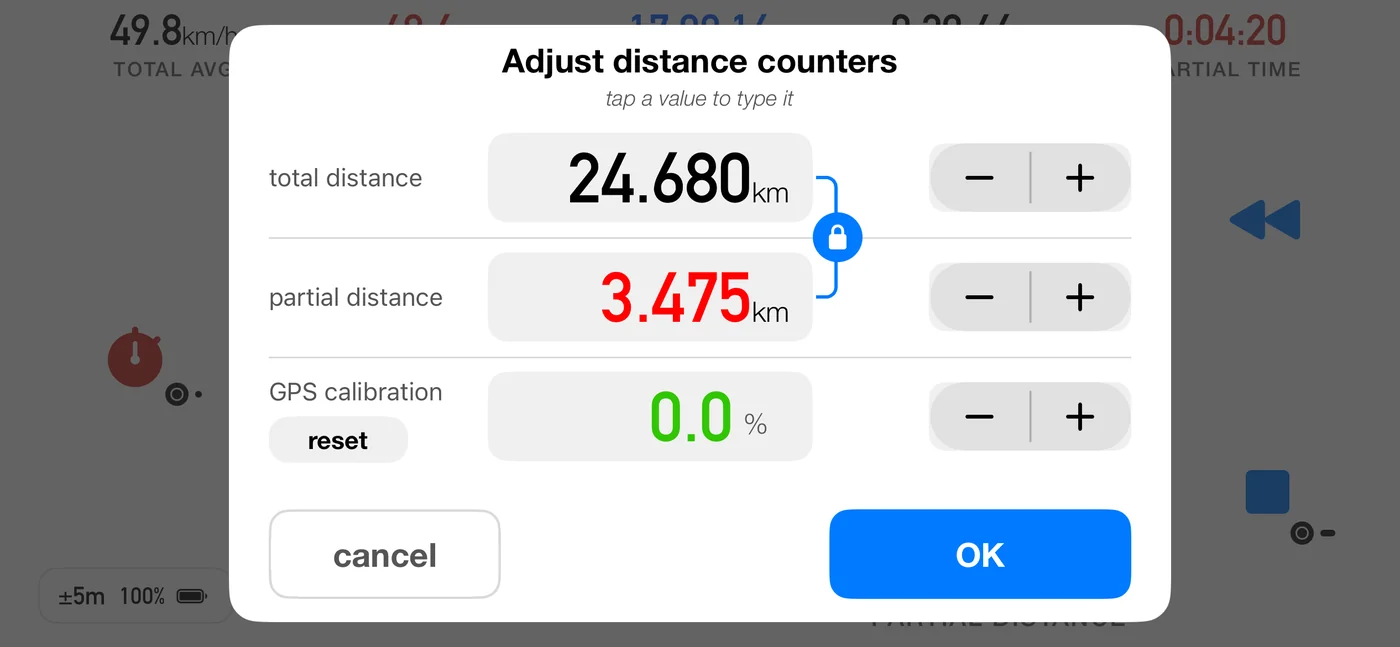
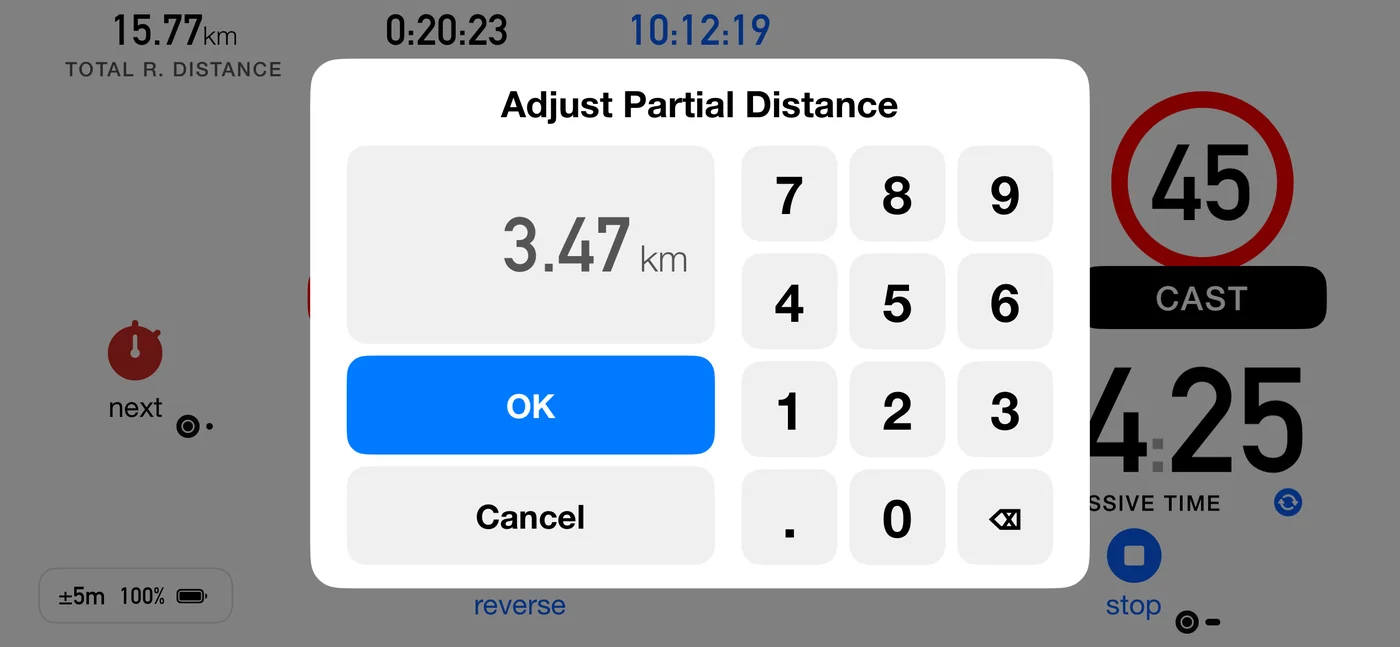
Double-tap a distance while running to open the adjust dialog.
- Adjust the total and the partial independently, or link them with the lock.
- The ± step is Settings ▸ Controls ▸ Adjustment steps: ±1 (default), ±10 or ±100.
- You can also type a value.
- The calibration chip sets the correction as a percentage, in 0.5% steps, up to 30% either way. It is the quickest way to calibrate in Classic, which has no calibrate button.
When you apply:
- If you moved while the dialog was open, the app says how far and asks whether to apply anyway or cancel. Outside Roadbook mode it also offers to restart with the updated data.
- If you changed a distance and have no calibration set, it offers to turn that correction into an overall calibration for the whole track. Accept, decline (the distance change still commits), or cancel. It is only offered within ±30%.
Typing a percentage by hand is bounded the same way: Calibration must be between -30% and +30%.
7.5 When a calibration is active
Distances shown are the corrected ones, average speeds are computed from them, and a chip shows the active percentage beside the dashboard captions.
A calibration belongs to the car, so it is kept as a setting. It persists until you change or reset it. Stopping a run does not clear it, and neither does closing the app or iOS shutting it down in the background on a long liaison or overnight. The switch that applies it is kept with it, so a calibration is never restored in a state where it is loaded but not in use.
Changed: before this, a calibration lived only inside the crash recovery data, which the app deletes at the end of a normal run. Calibrating, driving, stopping and then quitting the app lost it silently, and the next leg was driven on raw GPS with nothing on screen saying so. If you are on an older build, re-check your calibration after any restart.
⚠️ A scored part in a roadbook can be recorded on the authored distance instead of the measured one, which is a setting and is separate from calibration. It is on by default, and the first leg where the two visibly disagree offers you the other basis. See 6.11.
7.6 What else moves your numbers
| Factor | Effect |
|---|---|
| Reverse | Distance is subtracted while it is engaged |
| Pause | No distance accumulates, and measuring restarts from your position on resume |
| Reduce GPS when parked | Lowers GPS power while stopped; full accuracy returns when you drive |
| Units | Settings ▸ Units & Format ▸ Units: Auto (default) follows the device region, Miles or km override it. This choice governs the driving screen at all times, including while you follow a roadbook written in other units, so the display can match your car's odometer |
| Distance format | Display only, with no effect on measurement. While you follow a roadbook, the driving screen shows the roadbook's decimals instead, so the figures match the page |